1
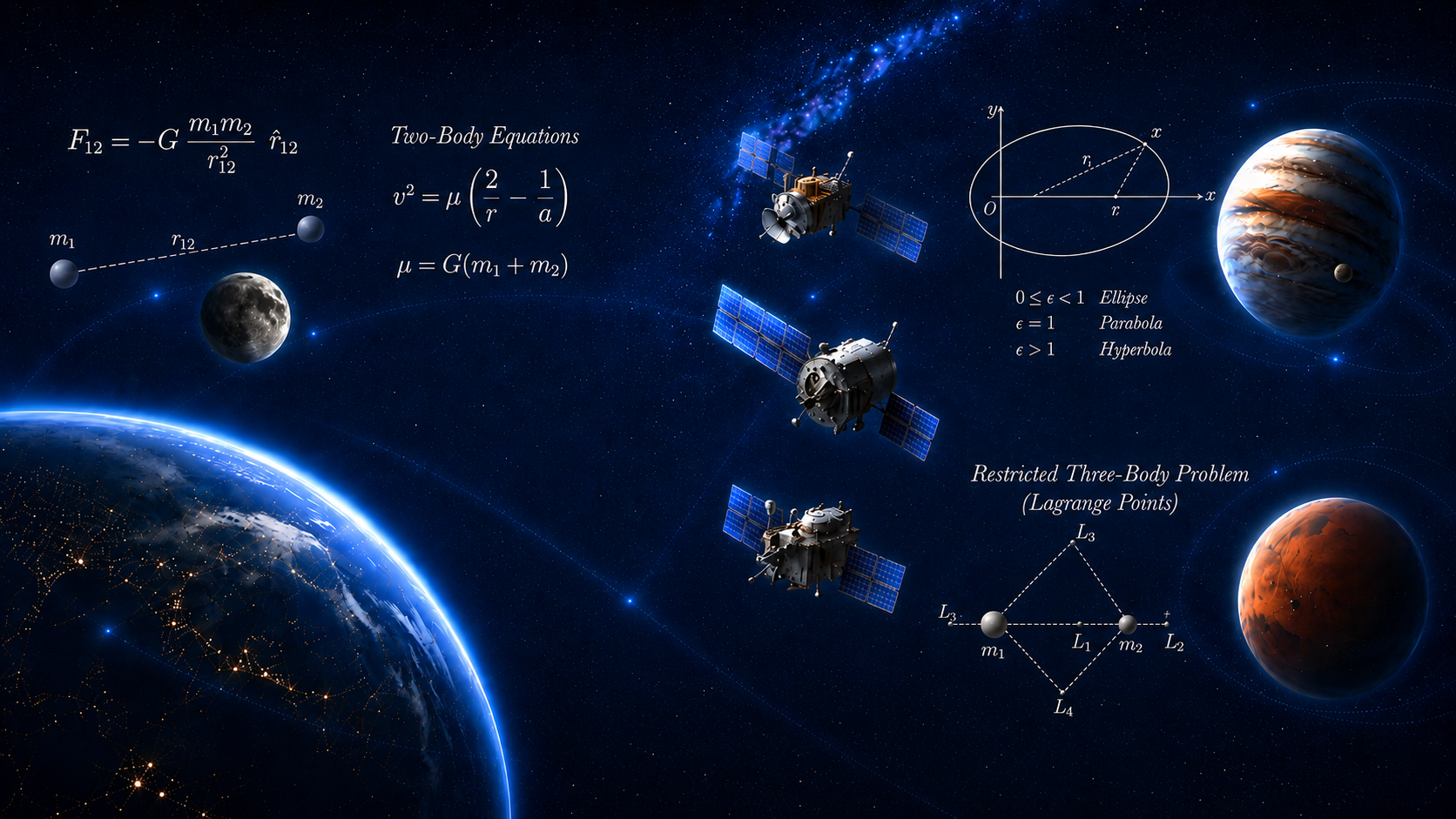
The N-body problem
Periodic and quasi-periodic solutions, variational and perturbative methods, computer-assisted proofs and machine learning.
A meeting point for dynamical systems, mathematical analysis, mathematical physics, probability, numerical analysis, optimization and artificial intelligence methods applied to problems in space sciences.
Space sciences require a broad and complementary range of mathematical expertise.
From the N-body problem to trajectory design, from the modelling of plasmas and planetary atmospheres to the interpretation of large cosmological datasets, SPACEMATH was created to foster interaction among researchers with different expertise and to build a nationwide interdisciplinary network.
Mission and objectives →Examples of topics combining methods from pure and applied mathematics with central problems in space sciences.
Periodic and quasi-periodic solutions, variational and perturbative methods, computer-assisted proofs and machine learning.
Invariant manifolds and optimal control for dynamically feasible and efficient transfer orbits.
Celestial mechanics, statistical mechanics and fluid dynamics for complex particle systems.
Harmonic analysis, stochastic geometry, numerical analysis, optimization, wavelets, neural networks and generative AI.
SPACEMATH plans regular scientific events, interaction with the space sector and public outreach.
One webinar every two months.
One workshop each year, also featuring international guests.
An annual meeting with the space industry and the Italian Space Agency.
An annual public conference on the role of mathematics in space sciences.
Interaction with agencies, research centres and industry is an integral part of the SPACEMATH vision.
The group aims to connect real problems in space sciences with advanced mathematical tools, while supporting the training of PhD students and postdoctoral researchers and their integration into universities, research centres, space agencies and companies.
Collaborations and training →