Research
Mathematical methods for space sciences.
The topics listed below are examples of themes that the SPACEMATH Working Group intends to discuss. All of them are strongly interdisciplinary and multidisciplinary.
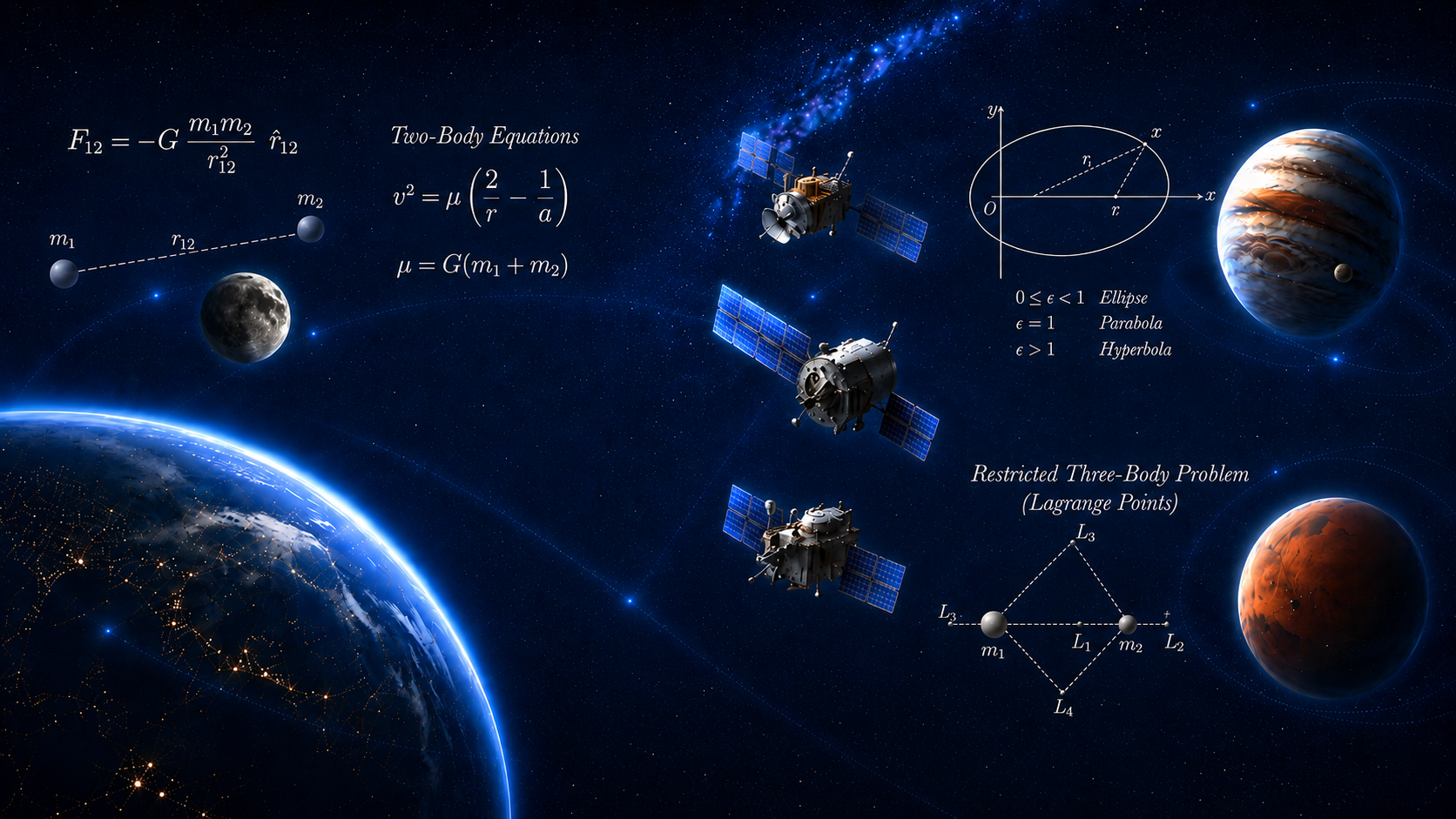
Periodic and quasi-periodic solutions of the N-body problem
Comparison of variational and perturbative methods, computer-assisted proofs and machine-learning techniques for the determination of invariant structures in systems subject to mutual gravitational interaction.
Low-energy trajectories
Study of transfer orbits derived from invariant manifold theory, combined with advanced optimal-control methods to ensure dynamical feasibility and efficiency in interplanetary missions.
Models for systems with a large number of particles
Protoplanetary nebulae, ring systems and Kordylewski clouds can be studied through the combined use of methods from celestial mechanics, statistical mechanics and fluid dynamics.
Analysis of cosmological and space data
The growing amount of data acquired by satellite experiments requires new tools for processing, management, storage and interpretation. Relevant methods include harmonic analysis, stochastic geometry, numerical analysis and optimization, wavelets, neural networks, generative artificial intelligence and other areas of pure and applied mathematics.